



Easter Traditions and Symbols: The Meaning of the Easter Egg and Why the Candle is the Light of Spring
Share
For many of us, Easter means decorated eggs, ham, "boba" (a type of sweet bread), and family at the table. But we rarely consider why precisely the egg, why precisely the candle, and what all this means deeper than just "festive decoration." And the meaning here is much more than meets the eye.
Lithuanian Easter stands on two legs: one Christian, the other pagan. And it is this dual layer that makes our traditions so rich.
Easter before Christianity: when everything began with the earth
Lithuania was the last European country to officially adopt Christianity in 1387. But old forms of faith persisted for another couple of centuries after that. Therefore, an incredible number of pre-Christian spring celebration traces have remained in our Easter customs – such that you won't find anywhere else in Europe.
The word "Velykos" (Easter) might be related to "vėlės" – the souls of the dead. Ancient Lithuanians believed that on the spring equinox, the souls of ancestors rose from the earth and wandered until the first spring thunder – the work of Perkūnas – calmed them. Good Friday was called Vėlių Velykėlės – the small Easter of the ancestors. Families visited cemeteries and left eggs for the deceased.
The spring equinox marked the farmers' New Year. It was a cosmic turning point: Perkūnas, the god of light, took over power from Vėlinas, the god of the underworld. Women ran through villages singing, announcing spring. People bathed in rivers, swung on swings – all this was meant to awaken the earth from its winter sleep. According to ethnologists, the origins of Easter, as in all agrarian societies, are associated with the rebirth of nature, and the Christian understanding in Lithuania only became more firmly established in the 18th-19th centuries.
Margutis – not a decoration, but a miniature cosmos
The word "margutis" comes from "margas" – colorful, patterned. But a margutis was never just a beautiful egg. It was a sacred object.
Archaeologists found artificial decorated eggs made of stone, clay, and bone, dating from the 11th-13th centuries, on Gediminas Hill in Vilnius. The first written mention is from 1549, when Martynas Mažvydas, author of the first Lithuanian printed book, mentioned the gifting of decorated eggs.
Gifted margučiai were never eaten. They were stored in a chest or behind holy images. Eggs were buried under the threshold of houses – for protection, in cowsheds – to protect livestock, in fields – for harvest, in gardens – for fruit trees. At the end of the 19th century, farmers would leave a margutis in the first spring furrow as an offering to Žemyna – the Earth Goddess.
What do the patterns on a margutis mean?
All traditional margutis patterns are created from just three basic wax strokes – a dot, a dash, and S-curves. But these three elements create an entire mythology.
Saulutė (little sun) – the most common symbol. A circle with rays or dots, signifying the life-giving sun, the eternal cycle of time. You'll find the same motifs on ancient Lithuanian distaffs, pottery, and iron crosses.
Žalčiukas (little grass snake) – an S-shaped curve, symbolizing the beginning and continuation of life. In Baltic mythology, the grass snake was a sacred household creature, the animal of the Sun Goddess. It was kept near the stove, fed milk, and believed to bring wealth. Killing it would bring misfortune. The word "gyvybė" (life) is related to "gyvatė" (snake) – the symbolism of life is encoded in the word itself.
Eglutė (little fir tree) symbolizes the eternally green tree of life – the World Tree, connecting heaven, earth, and the underworld, while a bird's footprint may be one of the oldest margutis symbols, associated with the Bird Goddess.
The margutis itself is divided into two parts by an ornamental band: the top – heaven, the bottom – the underworld. During Easter, the pointed end (heavenly side) is struck first, then the blunt end (earthly side) – symbolizing that in life, you first see heaven, and only at the end – the underworld.
And what about the colors? Red – the most important: life, fertility, warmth. The first spring egg had to be red. Green – rebirth, love. Black – the color of the earth, the soil from which everything grows. Yellow – sunlight, wealth. Blue – water, sky, wisdom.
In February 2025, "Wax egg decorating in Alytus region families" was officially inscribed in the Register of Intangible Cultural Heritage of Lithuania – the strongest recognition of this tradition at the state level.
Fire and light: An Easter symbol across Europe
The margutis is not the only Easter symbol with deep roots. Fire and candle light on Easter night unite all of Europe.
In Greece, on Holy Saturday, at midnight, every church is plunged into darkness until the priest proclaims: "Come, receive the light." The flame travels from candle to candle until the entire church is illuminated.
In Germany, on the evening of Holy Saturday, gigantic Easter bonfires – Osterfeuer – blaze, stemming from pre-Christian Saxon fire rituals. Ashes were scattered on meadows to improve the harvest – a direct equivalent to the Lithuanian tradition of burying margučiai in the fields.
In Finland and Sweden, Easter has its own unique fire tradition – bonfires are lit to ward off witches, and children dressed as "Easter witches" go from door to door with decorative pussy willow branches.
And in Spain, during Holy Week processions, thousands of penitents carry huge candles through the streets, children collect dripping wax as a souvenir, and saetas – religious hymns – emanate from balconies.
The Easter candle: where beeswax becomes theology
There is one Easter ceremony that directly connects beeswax, fire, and the meaning of resurrection – the Easter Vigil and the Paschal (Easter) candle.
A new fire is lit in the dark church. From it, the great Easter candle is lit and carried in procession. Raised three times, "Lumen Christi" – the Light of Christ – is proclaimed. From it, the flame passes to each believer until the entire building is illuminated.
This tradition dates back at least to the 4th century. And here's the most important detail: according to church tradition, the Easter candle must be made of pure beeswax. Not just any wax. Pure beeswax symbolizes the body of Christ, the wick – the human soul, and the flame – divinity. In the Easter Vigil prayer Exsultet – one of the most beautiful hymns of Christianity – it is directly stated: "Accept this candle... the work of bees and of Your servants' hands... nourished by melting wax, which mother bees created for this precious fire."
In Lithuania, fire also held a special place. On Holy Saturday, young people would go to church to bring back consecrated fire – they would carry it in a smoldering, dried birch bark basket. All Easter dinner had to be cooked over this sacred fire.
And beeswax in Lithuania is not just material for candles. Ancient Lithuanians had the bee goddess Austėja – patroness of flowers, bees, and pregnant women. Bees were called God's holy little insects. They could neither be bought nor sold – only given as gifts. A person who gave bees and a person who received them became bičiuliai (friends) – and this word in Lithuanian means a close friend. Bičiulystė – friendship – begins with bees.
The same beeswax that women in ancient times used to decorate eggs and offer to Austėja, today fuels the flame of the Easter Vigil in churches around the world.
A tradition that is reborn
During the Soviet era, Easter was called "Spring Festival," churches became warehouses, and teachers and civil servants risked their jobs if they attended services. But Easter had one peculiar characteristic: the first day was always a Sunday – a day off. Families celebrated behind closed doors, and egg decorating remained as "folk art," not as a religious act.
Today, we see a true revival of crafts. Over 1200 certified artisans participated in the Kaziukas Fair in Vilnius in 2026. The Dzūkija wax decorating tradition is officially recognized as heritage. More and more people are choosing natural materials – onion skins instead of chemical dyes, beeswax instead of paraffin.
This is not nostalgia. This is a living culture that finds a new form.
Margutis and flame – one story
When you look closely, the margutis and the candle tell the same story: life breaking through a closed shell, light being born from darkness, spring emerging from winter's grip.
The beeswax with which Dzūkija women decorate eggs is the same material that fuels the Easter Vigil candle. Bees, protected by Austėja – the goddess of bees – create wax that becomes both the pattern on the margutis and the light of the candle. The egg hides life. The candle illuminates it.
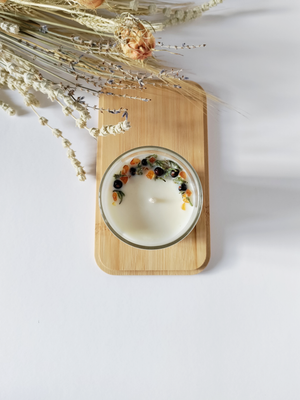
Therefore, an egg-shaped beeswax candle – "Margutis" – is something more than a decoration. It is two of the oldest Lithuanian Easter symbols combined into one object: the cosmic egg and the sacred flame, the earth goddess and the bee goddess, darkness before dawn and the light that fills it.
All Matėja Easter decoration collections can be found here, and handmade candles – here.


